This post and its comments have been moved to the way more awesome guitarforworship.com website. Click here to read this post.
I’ve been pretty open here about the times when I haven’t. When it was all about the guitar, hearing myself, feeling my tone, or unfortunately, most times, about making myself feel good about my sound. Or sometimes, the belief that the music simply cannot go on without the guitar being louder than any other instrument. And, if you subscribe to the belief that most of us guitarists do, that the music is the guitar, then I suppose this would be true. The interesting thing about all this is that, looking back on it, as I was trying to broadcast to people how good my tone was, and how well I knew music and had been around the block, and that the 100 watt amplifier ‘must’ be cranked to ‘get the tubes warm enough’ for maximum tone, I think I may have just been broadcasting how unprofessional I was. Broadcasting that if my amp wasn’t blaring, I couldn’t cover the deficiencies in my tone and playing anymore. Broadcasting that what ‘around the block’ really meant, actually really was playing on Sunset Boulevard. But paying $400 to play on Sunset Boulevard, opening for 7 other unheard of bands on a Tuesday at 5 PM, with a promoter who never showed. (Which is why, whenever I want to sound cool, I just say, ‘Oh ya. I’ve played the Roxy.’ I don’t mention the details. Because the details make it sound decidedly less cool. Maybe even bordering on sad. Alright. It’s just plain sad.) I wish someone had had the guts to come up to me and ask how in the world it was possible for my ‘knowing tone’ and ‘having been around the block’ to express itself in cranking a 100 watt amp in a small sanctuary, when Edge could get away with playing the Cannes Film Festival with a single AC30. Of course I would have had an excuse to deflect the question, but that doesn’t mean that amongst the soul-baring agnst and tears the next night over why someone didn’t like my tone, I wouldn’t have actually given the question some thought.
But no one did. (Thanks, everyone! If you’ve ever thought I was too loud, well, looks like it was your fault. ;) ) And I had to figure it out on my own. And I’ve posted many times on this…and not so much on not so much keeping the stage volume low; on keeping the stage volume where you can help the music by getting great tone and feel from your rig, while also still managing somehow to blend and mix with the rest of the band. And I don’t want to run it into the ground. No…ya, I do. So, as I visited my second cousin’s church last weekend, amongst the more pressing family issues, I found something that gave me the excuse to post about this extremely important issue again:
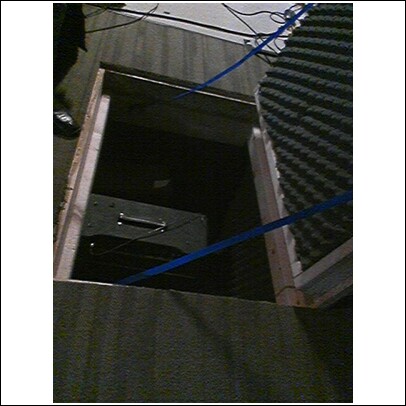
Very cool. That’s my cousin’s (who’s the worship leader over there) Bad Cat…in a soundproof trapdoor underneath the stage. And when I say ‘found something’, that doesn’t mean that I just randomly found a trapdoor in the stage after service, opened it up, and was like, ‘Hey cool! A Bad Cat!’ Not saying I haven’t had that dream before, but unfortunately this was reality, and it was Mark’s Bad Cat. ‘Found something’ also does not mean that during worship I’m wondering where the great tone is coming from because I can’t see an amp, and in my fervor to prove to myself that great tone can’t possibly come from running direct, I jump up on stage and start weaving through musicians, randomly opening stage trap doors looking for Bad Cat’s……as much as I can picture most of you imagining me doing that. But after the service, because I just can’t ever seem to help myself, I had to go on stage and ask him about his rig. And he showed me how he had asked them when they re-modeled the stage to put in two ‘amp tunnels’ on either side of it.
And I just thought that was the coolest thing ever. Not the trapdoors themselves necessarily, but the fact that keeping stage volume low in order to mix with the band meant so much to him. That he ‘gets it’, on both sides of the spectrum…both tonally, and in the way that that ‘good tone’ is meant to help the band. See, on the one hand, you usually get the guys who don’t realize what a good sound can do for the music as a whole, but they do get mixing with the band, and so they just run direct or through a POD or what-not, and sacrifice tone. (I know some of you may be doing this, and if you’re getting insanely good tone without an amp, then more power to ya! I’m just going on my personal experiences…not trying to say your tone is bad. hehe ;) Alright, covered myself? Good! hehe) And then on the other hand, you’ll get guys who know what good tone is, and have the most beautifully singing tone just soaring out of their 200 watt HiWatt……but then they totally miss how that amazing tone will help the music, because no one can hear the music. But here’s my cousin, a professional musician (you can check out his stuff at markalan.net ; he’s really humble, so he’d probably kill me if I mentioned the names of the people he’s worked with, but suffice it to say, he’s a professional musician), who gets and takes seriously enough both tone and also how it relates to mixing in with the band to create an overall good sound for the good of the music as a whole, enough to have something like this amp trapdoor built.
Now, you may not be able to call up your pastor, promoter, or owner of the club you’re about to play at for the first time and say, ‘Hey, by the way, I take tone and mixing with the band really seriously, so here’s what I need built before I come play.’ But you can take it seriously with other ways.
–Post Phase Inverter Master Volume
This is the one I’m stoked on right now. When I got my new Divided by 13, it sounded good. And loud. And I knew I needed that good sound, but at a lower volume. And I finally decided to try post phase inverter master volume. This is a mod done to the amp that takes the volume down at the end of the signal path. So you’re not choking out any of the circuits or tubes from getting signal, you’re just regulating it afterwards. I’d tell you exactly how it works, but I don’t know. hehe *Sigh* I’m again reaching some level of honesty that borders on stupidity. But the result of it working, is fantastic. I had, again, Jerry Blaha at Amp Crazy off Sunset, put this into my D13, and it’s amazing. It’s his own special design, and then he tailored it a bit, I think, to integrate with the D13. And it is smooth as anything. No tone loss when all the way up, utterly smooth while turning it all the way down. And almost the exact same tone at whisper volumes as when cranked. Pretty crazy. Obviously, the speakers aren’t being pushed as hard the lower it is. But everything else is pretty, pretty close, to the amp’s regular tone. Fantastic.
–Power Scaling
This one works just like a master volume knob, but is, in essence, cutting power in order to cut volume. At least, that’s what it did in its first incarnation. Different builders now have put their own spin on it. I believe Reinhardt was one of the first amp makers to do this, and now Suhr I think is kind of taking it further. The Suhr power scaling sounds really, really good. Mojave also does this, but…well, let’s just say Mojave turned me off to power scaling as a whole, until I was able to hear a Suhr. But this is another great option; although, because of its nature, I think I’d want an amp that had been built around power scaling, rather than having it put in as a mod.
–Good Master Volume, or with Tone Stacking
Most master volumes control the signal to and from the preamp tubes. Some suck. Some are great. The good ones usually have some sort of tone stacking, which again, I don’t pretend to understand. However, it is able to maintain your tone by ‘stacking’ it (look how technical I am!), even as you turn the master volume down. You usually just have to try the amps out to see if the master volume maintains tone at low volumes, or completely sucks the life out.
–Half Power Switches
These cut out half the power tubes. Or, on some amps these days, 3/4 of the power tubes. Extremely useful, and with very little tone loss, as it’s in essence, making your amp into a lower wattage amp. The circuit just simply doesn’t flow into some of the tubes anymore, on a well-done half power switch. Very cool mod to do to the amp. Some amps come with these already.
–Baffling
Yep. Takes the edge off, but barring building an entire mini room on stage, usually not entirely effective.
–Isolation
If you have good monitors, this can be a great solution; just like my cousin’s church’s amp trapdoors.
–Attenuator
These are external units that connect your amp to your speaker cabinet. They are, in essence, an external post phase inverter master volume. Be careful of the cheap ones as they will blow your amp! But some of the quality ones, like the Ultimate Attenuator, the Ho Attenuator, or the Richter, can actually do a very good job of giving you the same warm tube tone at lower volumes. The nice thing about these, as opposed to mods, is when you’re an idiot like me and change amps every week, you don’t have to mod each one…just use the same attenuator. hehe
–Running Direct from a Preamp
Some amps have direct outs, or you can buy dummy loads that have direct outs and that you plug into your amp’s speaker output, or you can get either rackmount or pedal preamps with direct outs, some of which are actually tube-based. And these can sound very decent. However, you do lose the actual ‘turning the electric signal back into a soundwave’ realness of actual speakers, as well as the power amp section, which I think is hugely important. As such, this is not my favorite option. Some people love it, and if you get good tone out of it, then good times. :)
–Running Direct from an Axe-FX, POD, or other Amp Modeler
Eehhhh…
I can’t argue with people who get tone they love from these. I’m just not one of them.
–Running into a Direct Box
No.
Well, I might actually do this with a good guitar before I’d use an amp modeler. Signal is still kept intact, and if you have a guitar with good wood and pickups that has good acoustic response, then this can sound decent.
But…um…gets amps, folks. And hopefully this list gives some options of how to be able to get that good amp tone at low volumes without having to sacrifice playing through an amp. But also not sacrificing the good that that amp is going to do for the music because you’re too loud. There’s a balance to be found between that fantastic, cooked tube tone, and between using that tone to mix with the band and help the music as a whole. And when that correct balance is found, it ends up being better than either of the two ends of the spectrum on their own.
Splendid.
Karl.
 Guitar for Worship