And into guitar tone; in the purest sense of the word. Not the tone of your overall rig, but the tone of your instrument itself. We’ve kind of gone backwards in my own personal (meaning ‘right’, of course ;) ) hierarchy of tone. We discussed the pedalboard tone first, which I consider to be the least important. Then we delved into amp tone, the middle importance in electric guitar tone. And if you missed those, you can find the links in the archives to your right. There’s 2 parts of pedalboard tone, and 5 (and a half…hehe) parts of amp tone.
Now I don’t know if everyone’s like me in this area, but I had issues with actual guitar tone. See, the guitar is your instrument; the amps and pedals are tools, and necessary ones at that, but the guitar is what is supposed to be producing the actual sound. And somehow, in my mind, I got it backwards. I guess I saw all the people playing either Gibsons or Fenders and hence, wanted to be different. (I have this thing about needing to be different…sometimes it’s good, other times it’s really, really bad. This is one of those times it was bad.) So I decided (without putting it into actual words of course, because that would have horrified me…it’s amazing in life how much we can convince ourselves that things are okay by simply just not thinking about them too much) that people would be much more impressed with a huge pedalboard (or two) and a huge stack of amps (or three). And then everyone would just be overcome with awe and hail me as the new Steward of All Things Toneful when they saw that my teary-eyed, brilliant tone was coming from none other than a Squire guitar. (Well, BC Rich Mockingbird at the time…which ws a problem…even if the tone had been amazing, which it was not, that guitar is so ugly that your brain will literally reject the idea that any good sound could be coming from it.)
So I built up two enormous pedalboards, ran two amps in stereo, a third amp for ambient sounds, and then sent a signal through all that from a Delta Les Paul. (I know, you’ve never heard of them. Neither has anybody else. Which is what I dug about them. And which is also what made my tone bad. Well, that, and running through about 33 pedals with the signal split 4 times, and no buffers or bypass loopers of any kind. Holy tone suck, Batman.

(Here’s the Mockingbird, in all its splendor. Yes, play on stage with that guitar at church. Little distracting. And a lot cheesey. And if you play one of these, please know that I am not saying that you have bad tone. Some of the higher end models from the ’80’s actually sounded pretty good. But I am saying that you play an ugly guitar. Nothing I can do about that. ;) But just melt our faces off with tone, and we’ll all shut up. hehe)
And even later, when I had streamlined both my pedalboards and amps into being more toneful, I still hadn’t let go of wanting to get that elusive tone in my head out of these no-name guitars. And it wasn’t a question of money…I could have sold 10 pedals that I never would have missed, and bought a much better guitar. No. Money would have been a good excuse; being an idiot was not.
So needless to say, I have been through the gamet of guitars. I’ve had the cheap stuff (late ’90’s Squire, BC Rich Bronze series), the sleeper-supposed-to-be-custom-made-but-you-can-tell-they’re-off-an-assembly-line-in-China stuff (Delta, Brawley), and the vintage sleepers (1981 Ibanez Strat, 1978 Gibson The Paul, and 1975 Memphis neck-through). Notice that even when I started to give in and go with vintage name brand stuff, I still bought three ‘okay’ guitars, instead of pooling the money, selling some amps, and getting a really good guitar. Very unfortunate. And what I’ve learned through all this, is that, in my hopefully humble opinion, the guitar is the most important part of your sound. I would rather play a great guitar directly into the house system than play a junky guitar through a multi-thousand dollar boutique amp. And I know a lot of people disagree with that. And I do a little bit, too…it’s like saying, ‘Which would you rather have in a film, a great actor or a great director?’ And the answer of course, would be ‘Both.’ But you bring up the question anyway to bring into focus the importance of one the factors. So, the answer to having a great guitar or a great amp, is that one is no good without the other. But to magnify the importance, I would answer ‘Guitar.’
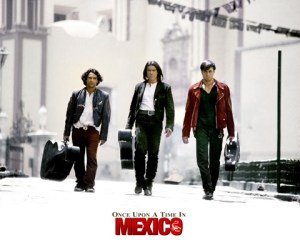
(And this is what happens when you get a bad director and a bad actor. Or two. Antonio Banderas and…in case you were wondering, yes, that is Enrique Iglesias on the right, trying his darndest to be cool. And yes, their guitar cases do have guns. Except for the big one on the left…that one is a remote controlled bomb with wheels. Excruciatingly bad.)
When I finally made the leap to a ‘real’ guitar, as Mike Huffman would say (for those of you who don’t know, this guy was one of my main tone mentors…he would have my try his pre-1995 PRS and ’73 Les Paul against my Delta…and when I would stubbornly tell him that there was just something about my Delta that I liked better, he would simply look at me with this frustrated look, and try to start like 50 words, before getting out, ‘No!’), the difference was immediate and final. It was such a relief off of my shoulders to listen to my tone and actually like it. Actually. Not convince myself I liked it. Not listen for the harmonics and think, ‘Oh those are what make up good tone, and they sound muddy in this room. When it’s mic’d, it’ll be amazing.’ (It is honestly incredible what the human mind can rationalize when it wants to.) No. It was an actual sound that pleased me without any rationalization. And more importantly, for art’s sake, a sound that pleased other people.
Now, this is not to say that you have to go out and buy a really expensive guitar. On the contrary, a large portion of the stuff coming out of Fender, Gibson, Ibanez, PRS, etc. right now is not very good. But, there are some expensive guitars from boutique builders or from 25 years ago, that are very, very good. And those are fairly expensive. Now here’s where I’m going to get some disagreements: you know that old adage, ‘You get what you pay for?’ Ya. Unfortunately, it is most often times true. Now, that’s not to say that you can’t have a great sounding cheap guitar. You know, the one that you found in the pawn shop in Hollywood, that was made by some washed up guitarist who could never make it, but with his dying breath, finished the most immaculate guitar ever conceived, and it somehow ended up in this hole-in-the-wall place on Sunset. (Seriously, I have actual dreams about this stuff; I’m salivating just thinking about it right now. For all my talk, I still haven’t quite broken myself of this dream. hehe) Or the guitar from DeArmond that just happened to be made with this great sounding tree, and they accidentally wound the pickups to ’57 specifications, and it was set next to something in the warehouse that made the pickups age properly, and the guy setting the neck onto it just happened to have been the luthier who had fallen on hard times and gotten a job of DeArmond for one day, and happened to put that guitar together. And I’m exaggerating, but stuff like this does happen. Over the (literally…which is very, very sad) hundreds of pedals, amps, and guitars I’ve owned, I’ve found maybe two that something close to this had happened. The thing that should not sound good, but it somehow does. But they are very, very few and far between.
Over the course of this guitar tone series, we will go into some tips on what to look for in an inexpensive guitar that will make it sound good. You can find them. But, if you have the means, I would suggest selling a couple pedals, and buying a high-end, custom made guitar, or a vintage guitar, and just see for yourself. If I’m wrong, you can sell it again, and perhaps even make a little money. But the impact might just stun you. And note that pedals and amps just ‘effect’ and ‘amplify’ your tone, in general. Ya, they help it (especially amplifiers), but a good tone from a guitar will make all your pedals and your amp sound better. The other night I met a guitarist who was playing through an amp I really dislike. And he still had the stock tubes and speakers in there. But he had a ’70’s Gibson. And the tone was very good.
And if you totally disagree, then awesome. But I’d urge you just to try one. For the sake of the fact that your guitar is your actual ‘instrument.’
For what it’s worth, here’s the guitars I’ve had that has very good, decent tone and that I got steals on. I would highly recommend both these instruments.
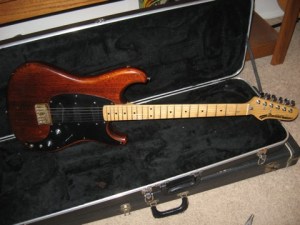
(1981 Ibanez Blazer series strat. Got it for $15o, set it up, and put in new pots and switches. For the money, a very good sounding guitar.)

(1978 Gibson Firebrand The Paul. Got it for $400. For a vintage Gibson, these are steals and sound very good.)
And for what it’s worth, here’s the guitars that changed my world. Always remember, good tone can change the world. Really wish I was joking right now; but no, I actually believe it.

(Gerard Melancon Pro Artist S. Solid aged ash body (with chambers), Lindy Fralin blues pickups, solid maple neck. Very expensive, but I got it used for not much more than a new USA Fender. Seriously, if you’re patient on the used market, you can get some high-end gear without selling off members of your family.)

(Sorry, the best picture I have of the Prairiewood has me in it, too, trying way too hard to look like a rockstar at church. And no, I do not have sunglasses on, indoors, during worship. It’s weird lighting. But that’s the Robert Dixon Prairiewood. Solid aged mahogany body, solid mahogany neck, 2 piece flame maple top, Wolfetone Dr. Vintage pickups, locking tuners, and coil tap. Again, I got it used, for not much more than a new Gibson. And I only mention all the specs to show what you can get if you start looking away from the big companies. Well, and because you do fall in love with your guitars. ;) )
Now I got both those used, as opposed to ordering them from the builders, which would have been a lot more expensive. Here’s a quick guide of some less expensive, moderately expensive, and expensive guitars (and all those relate to price, not build quality or tone, necessarily).
Less Expensive:
–Pre-1990 Squire. (I’m serious…they used great wood and decent pickups in these. The earlier the better.)
–Laguna. (These are at Guitar Center, and former luthier Keith Brawley designs them. He does not build them, but they are still designed by him. I’ve tried them, and they sound surprisingly good.)
–Ibanez Artcore series hollowbodies. (Again, surprising.)
–Schecter. (For a more metal-ish tone, if that’s what you’re after. Make sure you get the Seymour Ducan pickups, not the ‘Duncan designed’ ones.)
–PRS SE series. (Not nearly as good as the pre-1995 PRS stuff, but very decent for the price.)
–Early ’90’s Fender.
–Fender Highway series. (The Korean made ones from a few years ago.)
Moderately Expensive:
–1980-1988 Fenders.
–1978-1984 Gibsons.
–1980’s Greco (Gibson knockoffs.)
–Pre-1980 Ibanez (Gibson and Fender knockoffs. Ibanez used to be a lawsuit company.)
–Gibson Firebrands and The Paul’s. (Same as the Gibsons of the time period, but without the inlays and paint and pretty hardware.)
–New G&L
–Minarik (not sure…I haven’t heard these in a few years, and my ears may have ‘grown up’ since then. Or they may still sound very good.)
Expensive:
–Grosh.
–Collings.
–D’Pergo.
–Pre-1977 Gibsons.
–Pre-1979 Fenders.
–Prairiewood.
–1960’s Gretsch.
–Melancon.
–Pre-1995 PRS.
–Briggs.
–Suhr.
–Tyler.
–Anderson.
–Old G&L (Like, early ’90’s?)
–Gibson custom shop R8.
That’s definitely not a definitive list. But it’s a start. Next post in this series will go into what to look for in wood, pickups, hardware, and feel. But for now, remember that all these opinions from me or from anyone else are guides. They’re meant to help; use your ears as the final judge. And other people ears in the same room…because if you’re digging on your tone, but no one else is, it ceases to become art and becomes just therapy. ;) Especially those of you that are worship musicians…we’re really there for other people.
And remember, these are my findings based on my own limited experience. And my apologies to the world as a whole for ever playing a BC Rich Bronze Series Mockingbird. Just thank your lucky stars it wasn’t a Warlock. I know I do…daily.
Splendid.
Karl.
 Guitar for Worship